Are Douglas Fir Trees Safe Near Homes in Eugene?
Are Douglas Fir Trees Safe Near Homes in Eugene?
A Douglas fir can be safe near a home when it has a stable root system, sound trunk, healthy crown, and adequate growing space. Its height alone does not determine risk; root damage, decay, lean, deadwood, wind exposure, soil changes, and nearby targets matter more.
This guide explains how to evaluate a common tall Eugene conifer without assuming every large tree is hazardous for Eugene homeowners, landlords, HOA boards, and property managers. It is general information, not a substitute for an on-site tree assessment, a utility directive, an insurance decision, or legal advice.
Why the Answer Depends on the Tree and Site
Eugene properties combine mature Pacific Northwest trees with homes, fences, sidewalks, driveways, rental housing, commercial parking, and overhead utilities. Winter rain can saturate soil, wind can expose weak attachments, ice can add unusual weight, and dry summers can stress roots and crowns. A useful recommendation considers both the tree and what lies within reach.
Tree size is only one part of the decision. A smaller tree with severe root movement beside an occupied building may deserve faster action than a taller, healthy tree in an open area. The goal is to identify the actual problem, understand the likely consequence, and choose work that meaningfully improves the situation.
Key Factors for Are Douglas Fir Trees Safe Near Homes in Eugene
A tree professional will usually consider:
- root-zone disturbance from trenching, paving, excavation, or grade changes
- top dieback, sparse foliage, resin, bark damage, or signs of boring insects
- trunk cracks, cavities, fungal indicators, and old wounds
- recent windthrow nearby and changes that exposed the tree to more wind
- dead branches or a tall top over the roof, driveway, or neighboring property
These factors help distinguish routine maintenance from an urgent hazard. They also affect whether the practical option is inspection, selective pruning, cabling or bracing, full removal, stump grinding, utility coordination, or monitoring.
What to Do Next
- compare current canopy condition with older photos
- protect the root zone from compaction and construction
- inspect after major wind or ice events
- have significant deadwood and defects evaluated from the ground
- use a tree risk assessment when consequences of failure are high
If the tree is actively falling, resting on a structure, blocking a critical exit, or touching electrical conductors, keep people away and contact the appropriate emergency service or utility before approaching it. Photos are useful only when they can be taken from a safe location.
What a Clear Tree-Service Scope Should Include
A written estimate should identify the tree and explain what will be pruned, removed, supported, ground, hauled, or left on site. It should also address access, protection of nearby property, cleanup, permits or utility coordination when applicable, and any limits created by hidden decay, underground conflicts, weather, or site conditions.
For this issue, the most relevant starting point is tree assessments in Eugene, OR. If the correct solution is not obvious, an assessment before production work can prevent an unnecessary removal or an incomplete pruning scope.
Common Mistakes to Avoid
- topping a Douglas fir to reduce its height
- cutting major roots to protect a driveway without assessing stability
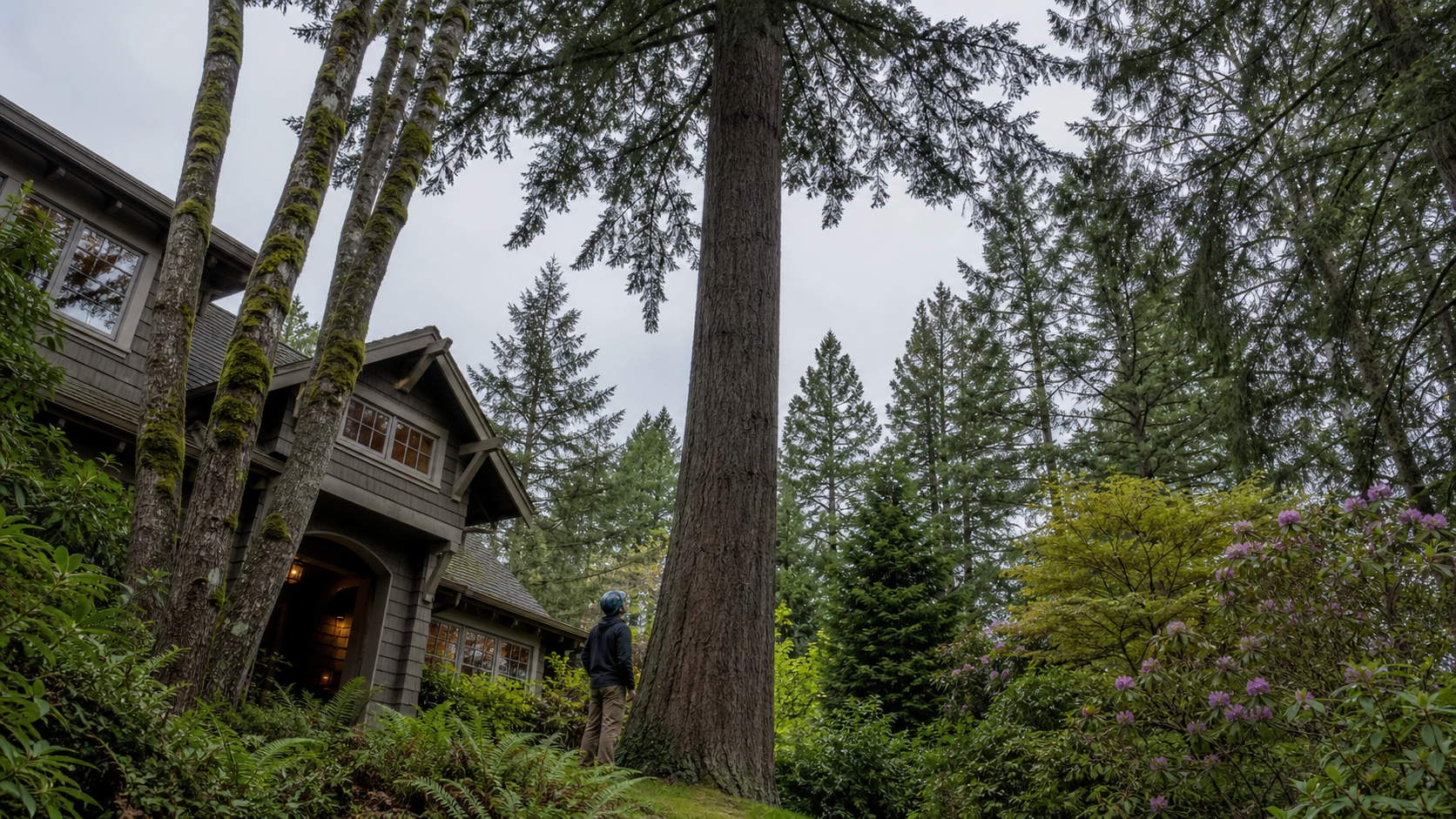
- assuming a tree is unsafe only because it is taller than the house
Do-it-yourself cutting becomes especially dangerous when wood is dead, split, storm-loaded, leaning, suspended, or near utilities. A chainsaw cut can release stored force or change the tree's balance without warning.
Related Eugene Tree Service Resources
Relevant services
- Eugene tree service location page
- tree assessments in Eugene, OR
- tree pruning in Eugene, OR
- tree removal in Eugene, OR
Related local guides
- What Are the Signs of a Dangerous Tree in Eugene, OR?
- What Should I Do If a Tree Is Leaning Toward My House?
- What Is the Best Time of Year to Prune Trees in Eugene?
Official Sources and Further Reading
Rules, pest boundaries, utility procedures, and agency guidance can change. Check the current source before acting:
- Oregon State University Extension tree-health guidance
- Oregon State University Extension guidance for trees on developed sites
Frequently Asked Questions
Do Douglas fir roots damage foundations?
Conflicts depend on distance, soil, construction, drainage, and root-zone changes; tree size alone does not prove foundation damage.
Should lower branches be removed?
Clearance pruning may be useful, but excessive live-branch removal can change tree form and stress.
How often should a large fir be inspected?
Inspect after major storms and when you notice change; the routine interval should reflect tree condition and nearby targets.
Get a Tree-Specific Estimate in Eugene
Eugene Tree Service can inspect the tree, explain practical options, and prepare a clear scope based on access and cleanup needs. Call (541) 515-7257 or request a free estimate online.